Pyomo provides a set of AMPL user-defined functions that commonly occur but cannot be easily written as Pyomo expressions.
Functions
sinc(x)
This function is defined as:
\[\begin{split}\text{sinc}(x) = \begin{cases}
\sin(x) / x & \text{if } x \neq 0 \\
1 & \text{if } x = 0
\end{cases}\end{split}\]
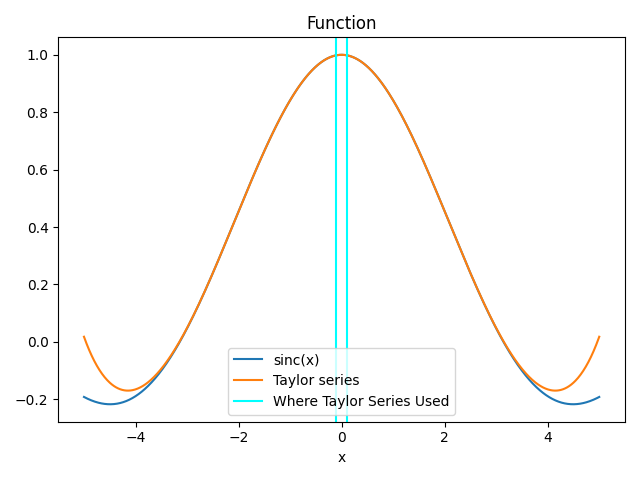
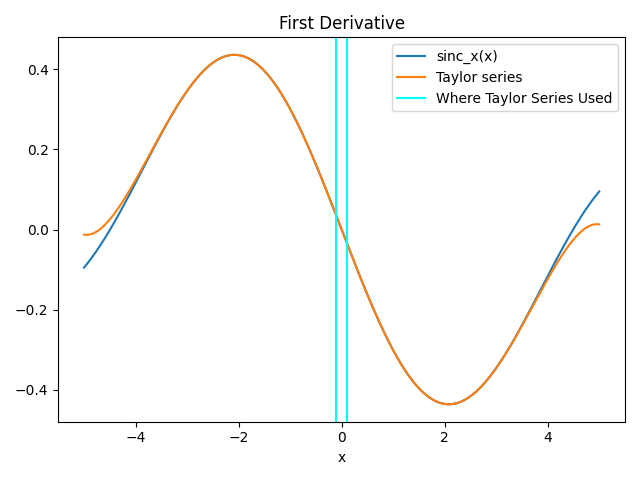
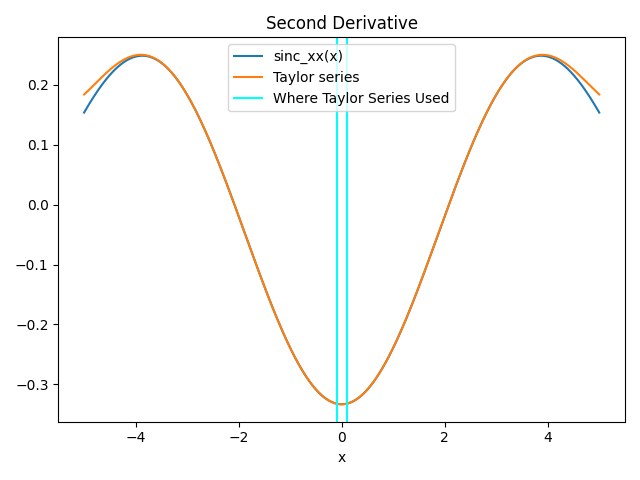
In this implementation, the region \(-0.1 < x < 0.1\) is replaced by a Taylor series with enough terms that the function should be at least \(C^2\) smooth. The difference between the function and the Tayor series is near the limits of machine precision, about \(1 \times 10^{-16}\) for the function value, \(1 \times 10^{-16}\) for the first derivative, and \(1 \times 10^{-14}\) for the second derivative.
These figures show the sinc(x) function, the Taylor series and where the Taylor series is used.
sgnsqr(x)
This function is defined as:
\[\text{sgnsqr}(x) = \text{sgn}(x)x^2\]
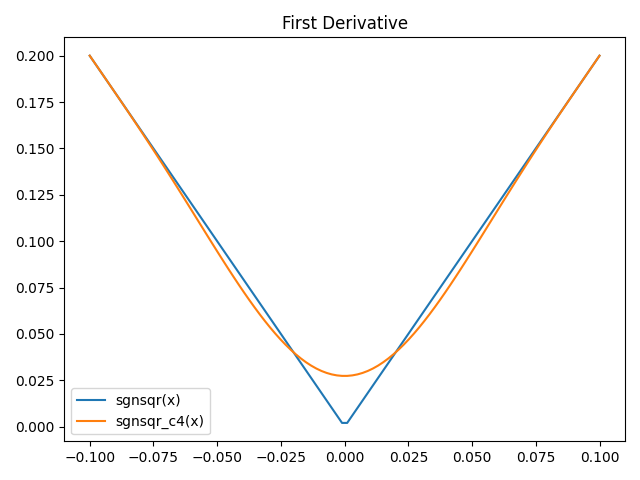
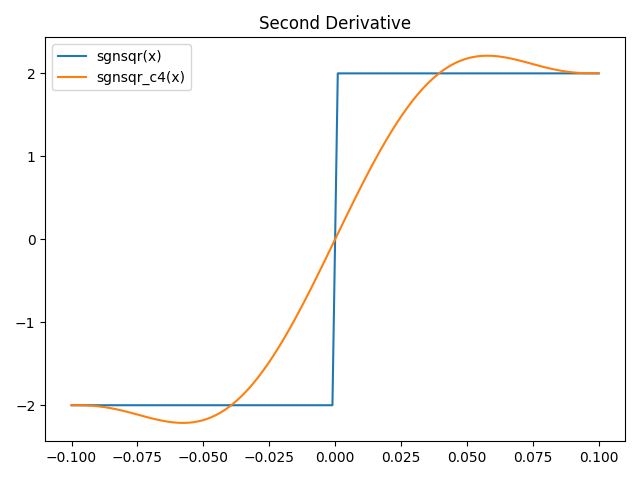
This function is only \(C^1\) smooth because at 0 the second derivative is undefined and the jumps from -2 to 2.
sgnsqr_c4(x)
This function is defined as:
\[\begin{split}\operatorname{sgnsqr\_c4}(x) =
\begin{cases}
\operatorname{sgn}(x)\,x^2 & \text{if } |x| \ge 0.1, \\
\displaystyle\sum_{i=0}^{11} c_i x^i & \text{if } |x| < 0.1
\end{cases}\end{split}\]
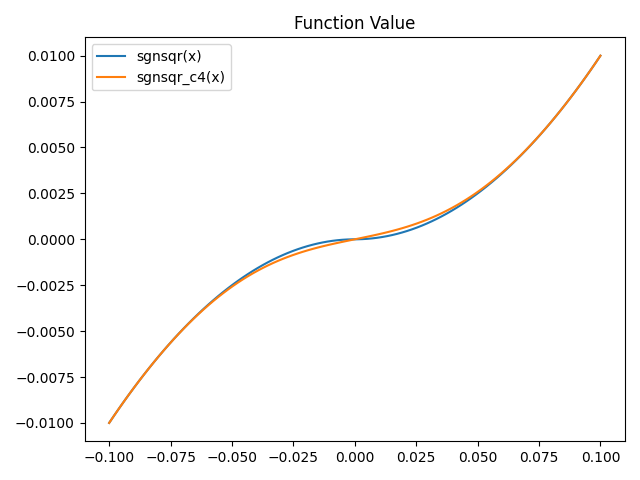
This function is \(C^4\) smooth. The region \(-0.1 < x < 0.1\) is replaced by an 11th order polynomial that approximates \(\text{sgn}(x)x^2\). This function has well behaved derivatives at \(x=0\). If you need to use this function with very small numbers and high accuracy is important, you can scale the argument up (e.g. \(\operatorname{sgnsqr\_c4}(sx)/s^2\)).
These figures show the sgnsqr(x) function compared to the smooth approximation sgnsqr_c4(x).
sgnsqrt_c4(x)
This function is a signed square root approximation defined as:
\[\begin{split}\operatorname{sgnsqrt\_c4}(x) =
\begin{cases}
\operatorname{sgn}(x)\,|x|^{0.5} & \text{if } |x| \ge 0.1, \\
\displaystyle\sum_{i=0}^{11} c_i x^i & \text{if } |x| < 0.1
\end{cases}\end{split}\]
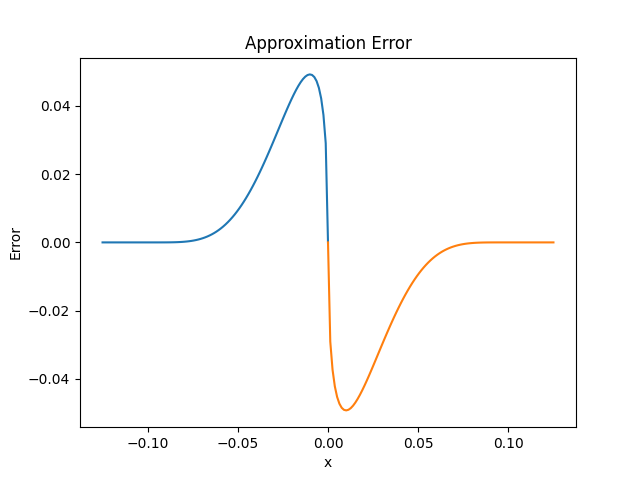
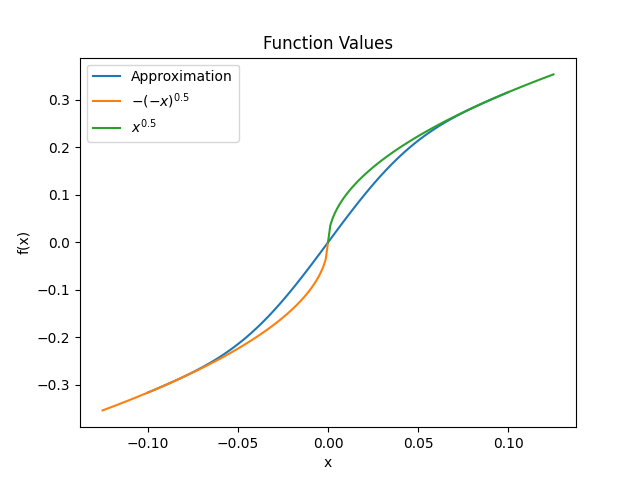
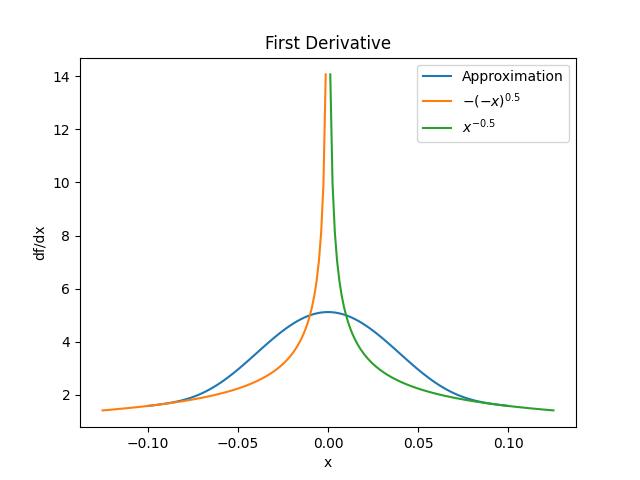
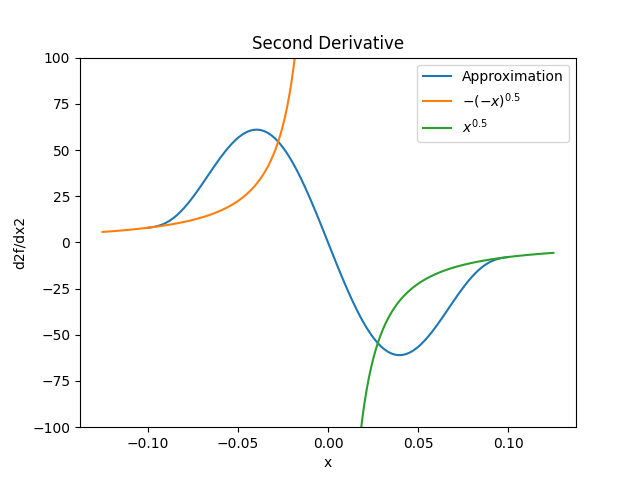
This function is \(C^4\) smooth. The region \(-0.1 < x < 0.1\) is replaced by an 11th order polynomial that approximates \(\text{sgn}(x)|x|^{0.5}\). This function has well behaved derivatives at \(x=0\). If you need to use this function with very small numbers and high accuracy is important, you can scale the argument up (e.g. \(\operatorname{sgnsqrt\_c4}(sx)/s^{0.5}\)).
These figures show the signed square root function compared to the smooth approximation sgnsqrt_c4(x).